Vocals Course
Our Vocals Course is designed for anyone who loves to sing — whether you’re just starting out or already building confidence in your voice.
At My HELM, we create a relaxed and supportive space where you can explore your voice, develop your sound and grow as a performer without pressure.
Through the course, you’ll work towards Rockschool grades while building real skills in:
- Vocal technique (breathing, control, range and tone)
- Pitch and harmony
- Performance and stage presence
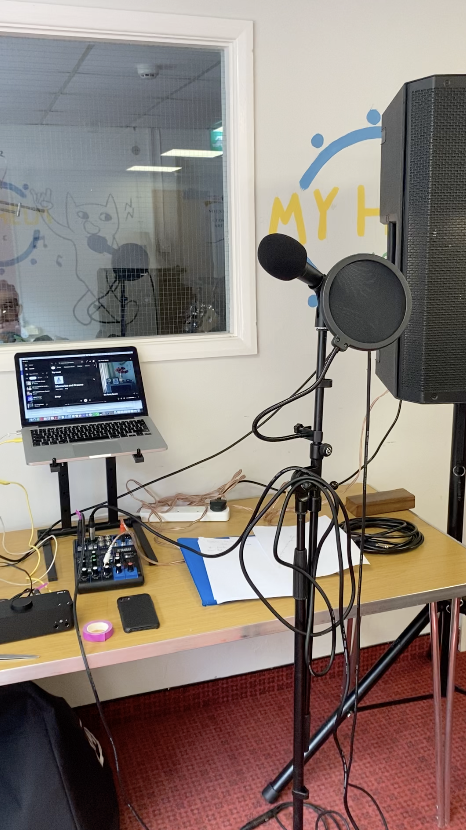
- Confidence using microphones and performing in front of others
You’ll also have the chance to:
- Sing a variety of songs and styles
- Experiment with your own sound and identity as a vocalist
- Work with others on group pieces and harmonies
- Develop your ear for music and improve your listening skills
Sessions are hands-on and creative, with plenty of opportunities to practise, perform and get feedback in a way that feels supportive and encouraging.
Whether you want to perform, record music, or just build confidence in your voice, this course will help you develop your skills and enjoy the process along the way.
By the end of the course, you’ll not only have improved your technique, but you’ll also feel more confident expressing yourself and performing as a vocalist.
Structure of Study
A Rockschool grade is built around a mixture of performance pieces, technical exercises, and musicianship skills. Students develop practical playing ability alongside a deeper understanding of music theory, listening, and creativity.
Each grade includes:
Performance Pieces
A set of 6 songs are published in the Rockschool book for the grade.
Students prepare 3 pieces for exam: these can be chosen from the Rockschool book, free choice pieces, or own compositions (if approved).
Songs are in a wide range of genres (rock, pop, blues, funk, metal, jazz, etc.), giving students stylistic variety.
Focus is on accurate performance, technique, tone, timing, and expression.
Technical Exercises
Specific to the grade and instrument (e.g., scales, arpeggios, rudiments, chord progressions).
Builds control, dexterity, and confidence across the instrument.
Exercises are graded to become progressively more demanding at each level.
Supporting Tests (Musicianship Skills)
Sight Reading / Improvisation: Students either sight-read a short piece or create an improvised performance over a backing track.
Ear Tests: Listening to short excerpts and answering questions (identifying intervals, rhythm patterns, chords, or stylistic features).
General Musicianship Questions: Exploring knowledge of instrument techniques, stylistic awareness, and performance approaches.
Theory & Understanding
Embedded into practical work, students gain a working knowledge of music notation, rhythmic values, scales, harmony, and stylistic conventions.
Reinforces how to read charts, follow lead sheets, or interpret written parts.
- Water bottle
- Snacks